The judges’ choice of Utzon’s bold and imaginative design was not without controversy. “From the first, it stirred the people of Sydney to breathless wonder and scalding abuse,” said Philpott. “It was called the Sydney Harbour monster, a piece of Danish pastry, a disintegrating circus tent.”
Premier Cahill, worried that the project might be derailed by adverse public opinion or political opposition, pushed for construction work to start early. This was despite the fact that Utzon was still finalising the building’s actual design, and had yet to resolve critical structural issues. Although Utzon’s design was thought to be one of the cheapest, there were still problems raising money for it, so a State Lottery was launched in 1957 to help fund the project.
The initial estimate of the final cost of the Sydney Opera House was put at A£3.5m or A$7m – at the time, Australia’s official currency was the pound, but was replaced by the dollar in 1966. The building was set to open on 26 January 1963: Australia Day. Both of these predictions would prove to be wildly and hopelessly optimistic. “Right from the beginning, the house was full of trouble: human, mechanical, structural,” reported Philpott.
The building of the Opera House was divided into three distinct phases: construction of the podium, the roof shells, and the interior. Cahill, having persuaded the Minister of Transport to agree to the tram depot being demolished to build the podium, “found the site was neither big enough nor strong enough to carry that structure that seemed on paper light enough to fly away,” said Philpott.
If you went into a taxi, you got an earful of all the money that was being wasted – Sir Jack Zunz
To bear the weight of the Opera House, the whole site needed to be extended and reinforced by driving over 550 steel-cased concrete shafts, each three feet in diameter, into land in and around Sydney Harbour. This extensive work, which had not been accounted for in either the construction’s budget or its timescale, dragged on, hampered by bad weather. The podium would only be completed in January 1963 – the original date for when the Opera House was meant to open.
But this would merely be the first of the project’s delays and eye-watering extra costs. The Opera House’s most distinctive feature, its roof shells which mimicked a ship’s sails, were to present a whole other set of engineering headaches. Initially, the plan had been to make the roof out of steel coated with concrete. However, that design presented unwelcome noise problems for any performance taking place. “The Opera House stars would have been singing above the sirens of the tugboats on the water outside, and the temperature variations would have caused the metal and concrete to rumble and crack like tropical thunder,” said Philpott.
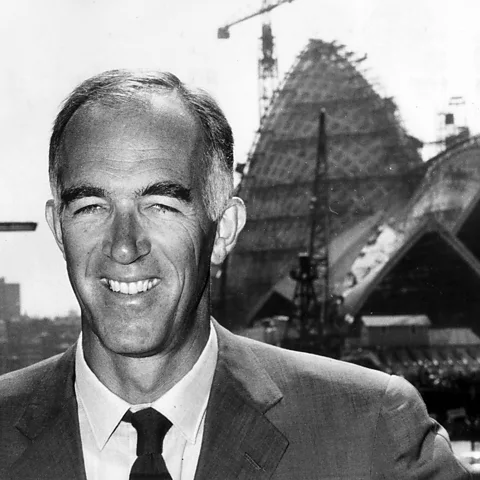 Getty Images
An unbuildable building
Nobody had also fully understood the scale of the engineering challenge that the Opera House’s daring curved roof surfaces presented. Since Utzon’s entry lacked detailed engineering plans, civil engineering firm Arup had been brought in to work out how to construct the roof’s complex shell structure. But despite trying multiple different redesigns, they could not make the structural calculations add up. “The first thing Arup did when they were asked to collaborate, they took these free shapes and developed a series of mathematical models which, near as possible, matched Utzon’s competition design. None of these shapes appeared buildable,” Zunz told BBC Witness History.
Another issue was that, because the roof was curved, each concrete rib that supported it would be different. That meant that instead of having just one mould that could be reused to cast all the supporting beams, each individual rib would need a separate one. This was prohibitively expensive.
The answer, Utzon would later claim, came to him while he was peeling an orange. The architect realised that all segments of the roof could come from the geometry of a single sphere. By identifying which part of the sphere best suited the shapes they needed, a series of triangles each with one curved side could be cut from it, creating a variety of shells. These spherical shell segments could be broken down into individual components, which could be uniformly pre-cast in concrete and assembled onsite. “He came back a week later and said, ‘I’ve solved it.’ And he made the scheme out of a sphere,” said Arup’s Zunz. “But in so doing, he had changed the architecture quite radically.”